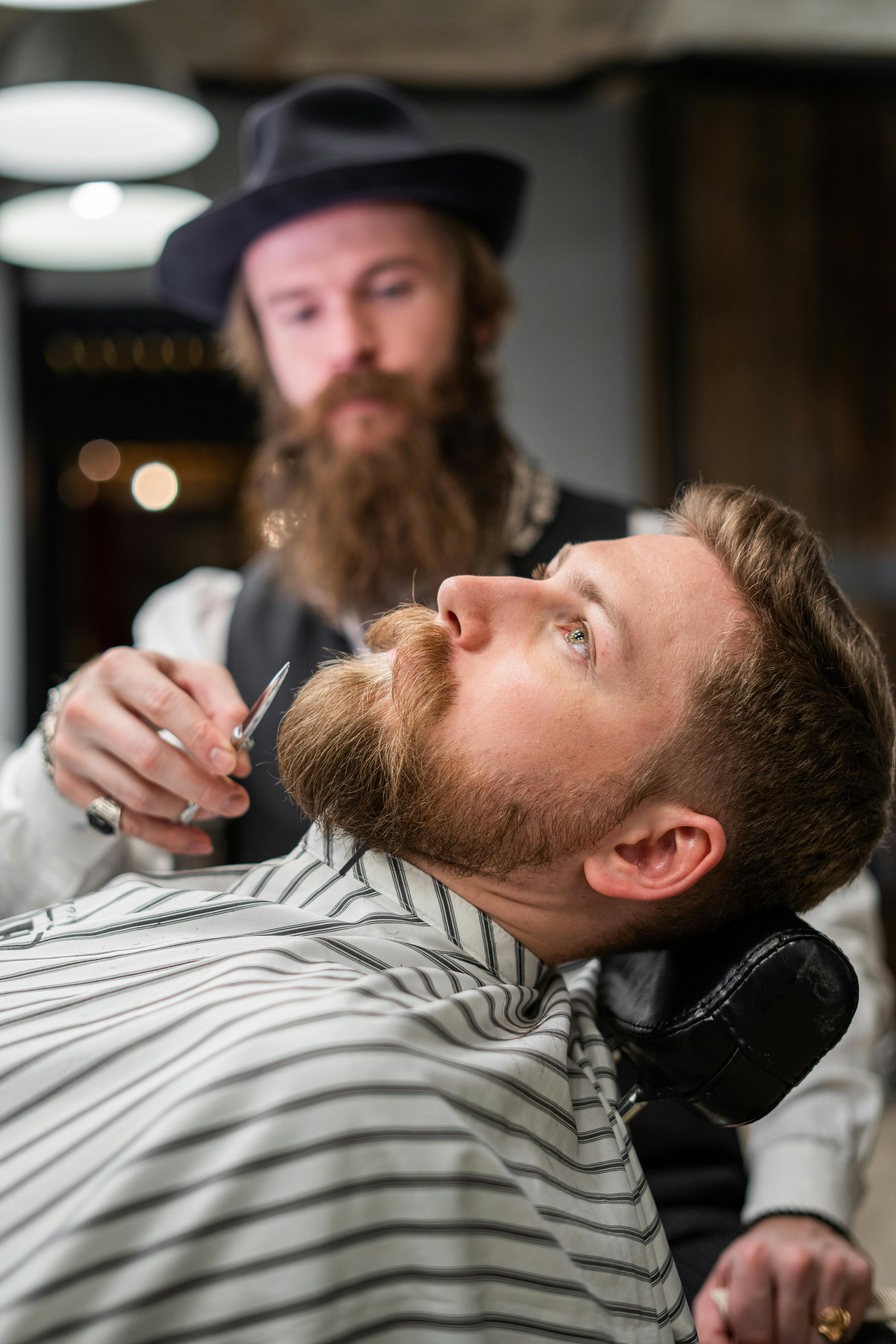
✂️ Fade vs Taper Haircut (Difference Explained) ✂️
Master the key differences between fade and taper haircuts. Discover styles, techniques, and tips to master men's haircut techniques.
Barber students and enthusiasts often hear the terms fade and taper used interchangeably, but they are not the same. Understanding the difference between these two haircuts is critical to mastering men's haircut techniques and delivering professional results in your barber training.
Knowing when to fade and when to taper separates a good barber from a great one.
A fade haircut gradually transitions the hair from short to longer lengths, usually on the sides and back. It's characterized by a smooth, seamless blend that starts from skin-level or very short hair at the bottom and increases in length as it goes up. Fades are highly versatile and can be paired with almost any hairstyle on top.
- ✓Low Fade: The fade starts just above the ears, creating a subtle look that suits conservative styles.
- ✓Mid Fade: Begins at the midpoint of the sides and back, giving a balanced appearance for most hair types.
- ✓High Fade: Starts high on the head, offering a bold, modern style that emphasizes the top hair.
- ✓Skin Fade / Bald Fade: The shortest fade where hair is shaved close to the scalp for a striking, clean look.
Fades require precision and control over clippers and guards. Professional barbers adjust taper levers and blend techniques to ensure there are no harsh lines, creating that smooth gradient effect.
A taper haircut gradually shortens hair along the hairline at the back and sides, but unlike fades, it usually maintains more length above and has a more subtle transition. Tapers are classic, timeless, and work well for professional or formal styles.
- ✓Natural-looking, subtle transition
- ✓Shorter at the neckline and around the ears
- ✓Maintains longer hair on top and sides compared to a fade
- ✓Less aggressive than skin or high fades
Tapers are ideal for clients who want a clean, polished haircut without dramatic contrasts. Mastering tapering requires understanding hair growth patterns and using a combination of scissors and clippers for blending.
While fades and tapers may seem similar, the differences are significant for technique, style, and maintenance.
- ✓Transition: Fades have a more dramatic transition from short to long hair, whereas tapers are subtle.
- ✓Length at the bottom: Fades often go down to the skin, while tapers keep some hair near the neckline.
- ✓Style Versatility: Fades are modern and bold; tapers are classic and conservative.
- ✓Maintenance: Fades may need more frequent touch-ups; tapers grow out gracefully.
Choosing between a fade and a taper depends on client preference, face shape, and hair type.
Mastering both haircuts requires the right barber tools:
- ✓Professional clippers with adjustable taper lever
- ✓Clipper guards for different lengths
- ✓Detail trimmers for edging and lining
- ✓Straight scissors and thinning shears
- ✓Combs and neck brushes for sectioning and blending
- ✓Hair clips and spray bottles for control
1. Start with clean, dry hair. Decide on fade type (low, mid, high, skin).
2. Begin at the bottom with the shortest guard or no guard for skin fades.
3. Gradually blend upward, switching guards for longer lengths.
4. Use the taper lever to fine-tune transitions.
5. Edge around the hairline with trimmers.
6. Blend top hair with scissor-over-comb if necessary.
7. Check symmetry and smoothness throughout.
1. Wash and comb the hair. Identify natural hairline and growth pattern.
2. Use a longer guard on clippers for top and mid-sections.
3. Shorten hair gradually near neckline and around ears.
4. Use scissors to maintain subtle transitions and blend into top hair.
5. Edge neatly around hairline with trimmers.
6. Ensure a natural finish that grows out gracefully.
- ✓Over-blending: too much fade on a taper can ruin the classic look
- ✓Incorrect guard selection: leads to harsh lines
- ✓Uneven hairline: check symmetry regularly
- ✓Neglecting hair type: coarse, curly, or thin hair requires adjustments
- ✓Rushing: fades and tapers require patience and attention
Precision, patience, and tool mastery are the hallmarks of a professional barber.
Check our step-by-step fade tutorials and scissor technique guides for complete barber training online.
🎬 Explore Tutorials →Click to master professional barber techniques!
Imagine a client requesting a high fade for a modern look. You must blend skin-level hair into longer strands without visible lines. For a taper client, subtle shortening at the hairline keeps a polished, conservative style. Both require observation, careful technique, and clean execution.
- ✓Regular haircuts maintain fade sharpness
- ✓Use quality shampoo and conditioner for healthy hair growth
- ✓Train with mannequin heads before real clients
- ✓Keep tools sharp, clean, and oiled
Understanding the differences between fades and tapers is essential for professional barbers. Mastering both allows you to meet client expectations, adapt to trends, and deliver polished results. Practice, patience, and the right tools make the difference between average and expert barbering.